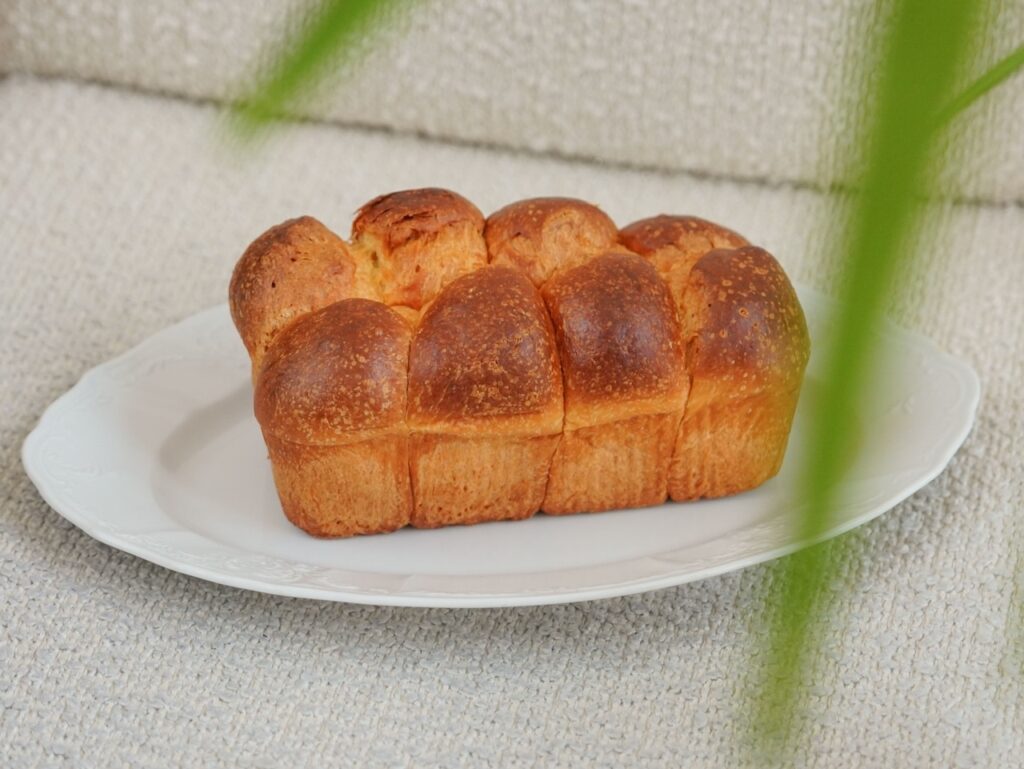
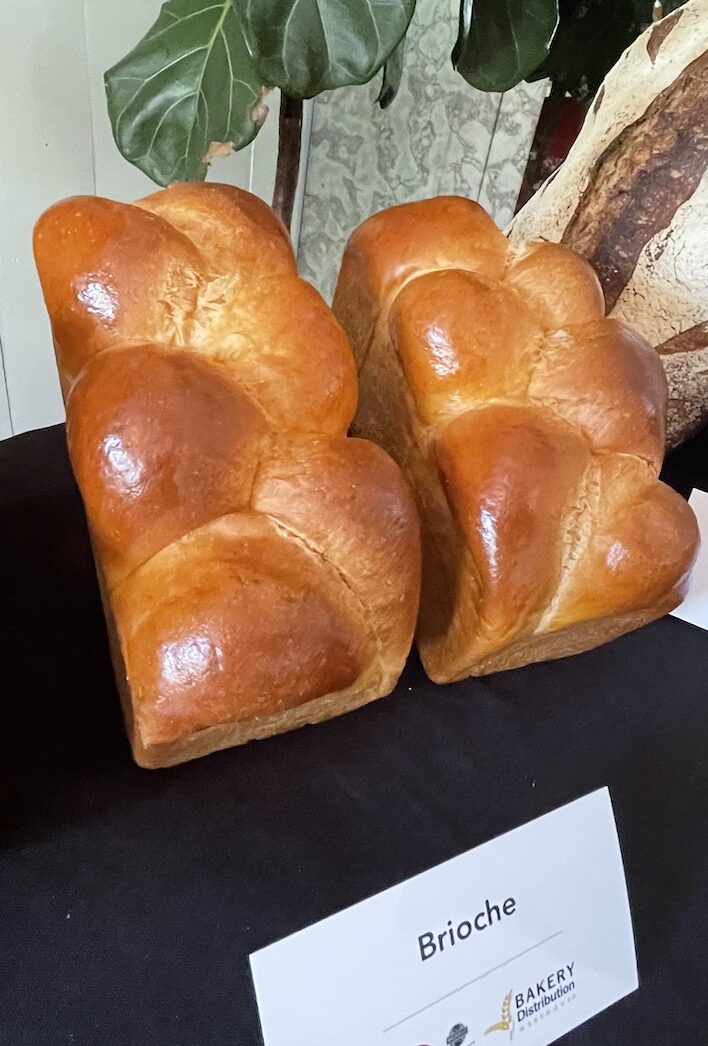
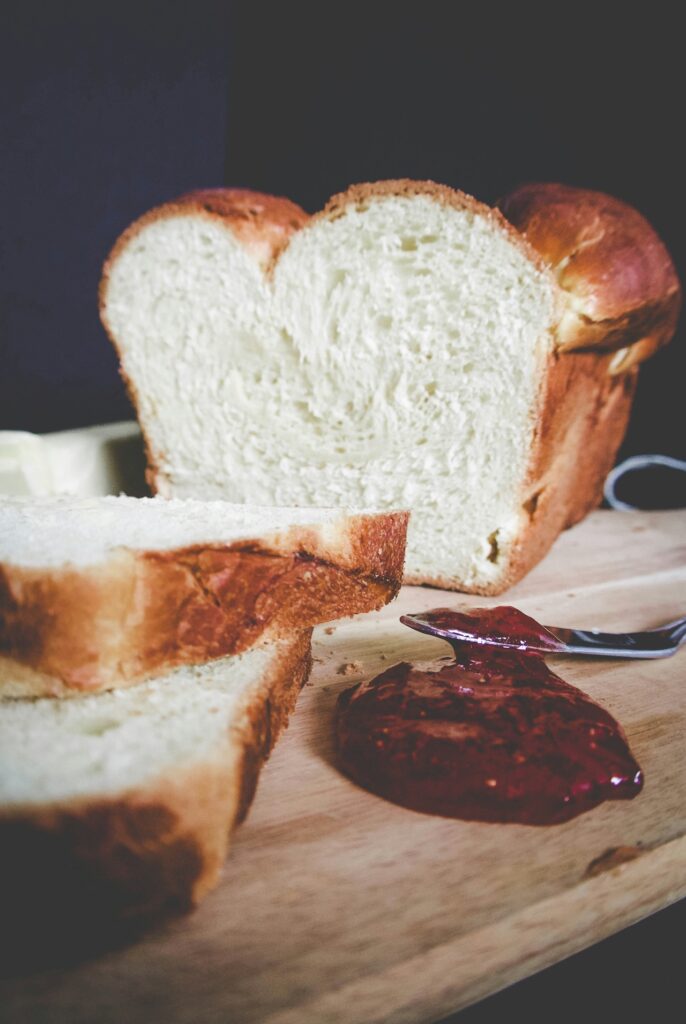
Less showy than the braided brioche, the Nanterre brioche is all about simplicity: small balls of dough placed close together in a loaf tin. During baking, they join together to create a soft, pull-apart crumb and clean slices when cut. This brioche became popular in the early 20th century, when Parisian bakers wanted a shape that was quicker to make. Today, it’s a classic, found in bakeries and on Sunday tables alike.
This dough is rich in butter and eggs, so it needs a strong gluten structure to hold together under all that fat. That’s why tradition usually calls for strong flour (T45), known for its strength and made for viennoiserie. But T55 “Cocorico” also works very well. It’s not the “expected” choice, but when kneaded well, with the butter added little by little, it gives a brioche that is just as delicious, with a crumb that’s a bit more rustic and less “fluffy” than one made with pure strong flour.
T55 “Cocorico” can be a smart, practical choice for both professionals and home bakers: one single fine flour, reliable and strong enough for both white bread and enriched doughs.
Recipe for 6 to 8 peoples
Ingredients
- 500 g T55 wheat flour “Cocorico”
- 20 g fresh baker’s yeast
- 60 g caster sugar
- 10 g fine salt
- 300 g whole eggs (about 6 medium eggs)
- 250 g soft unsalted butter (softened, at room temperature)
- 1 whole egg (for the egg wash)
- 1 pinch of salt (for the egg wash)
Instructions
In the bowl of a stand mixer fitted with the dough hook, add 500 g T55 wheat flour “Cocorico” (Foricher), 20 g crumbled fresh baker’s yeast, 60 g caster sugar, and 10 g fine salt (keep the salt and yeast apart). Add 300 g whole eggs (about 6 medium eggs). Mix on low speed for 4 minutes until the dough is smooth and pulls away from the sides of the bowl.
Increase to medium speed and knead for 12 to 15 minutes, until the dough is smooth, shiny, and stretchy, and clearly pulls away from the bowl (this shows the dough is well developed).
Without stopping the mixer (low to medium speed), add 250 g soft unsalted butter, cut into small pieces, one piece at a time. Wait for each piece to be fully mixed in before adding the next.
Knead for another 8 to 10 minutes, until the dough is smooth, soft, shiny, and pulls away cleanly from the bowl. (Windowpane test: stretch a small piece of dough, it should form a thin, see-through sheet without tearing.)
Cover the bowl with a cloth or plastic wrap and let the dough rise at room temperature (23-24° C / 73-75° F) until it doubles in size.
Gently press down the dough to release the air, fold it over itself, then cover it with plastic wrap (touching the surface) and place it in the fridge overnight (at least 8 hours, ideally 12). This cold rest firms up the butter and makes shaping much easier.
Take the cold dough out and divide it into equal pieces (about 130 g each for a large loaf tin, this makes 6 to 8 balls, depending on the tin size). Shape each piece into a tight ball to give it structure, then place the balls side by side, seam-side down, in a buttered loaf tin (a standard tin, about 25-30 cm).
Cover and let the dough rise at room temperature (or in the oven at 30° C / 86° F, turned off, with a bowl of hot water inside) until it reaches the top of the tin and has doubled in size. Do not let the temperature go above 28°C (82° F) during this rise.
Preheat the oven to 180° C (356° F) with fan.
Mix 1 whole egg with 1 pinch of salt for the egg wash. Gently brush it over the surface with a pastry brush, being careful not to deflate the dough.
Bake for 25 to 27 minutes, until the brioche is a deep golden color.
Take the brioche out of the tin as soon as it comes out of the oven, and let it cool on a wire rack. This stops the bottom from becoming soft and soggy.
Tips & tricks:
- Dough temperature at the end of kneading: aim for 24-25° C (75-77° F). If the dough is too warm, fermentation speeds up too fast and this weakens the gluten structure.
- The cold rest overnight is not optional for a true Nanterre brioche: it firms up the butter for clean shaping, and it develops flavors that a fast rise cannot give you.
- For a more professional finish: brush with egg wash twice (once before the 10-minute rest, then again just before baking) for a deeper, shinier color.
- Storage: this brioche freezes very well, either shaped and raw (before the final rise) or baked and already sliced.

To order your T55 wheat flour “Cocorico,” click here
(Photo credit: Pexel, Laurence Rousselot – Mots en tête, Léa Grandvalet – Image Me Photography)